
05 Oct 2026 4 min read
Banksy, Self-destruction and the Art of the Spectacle
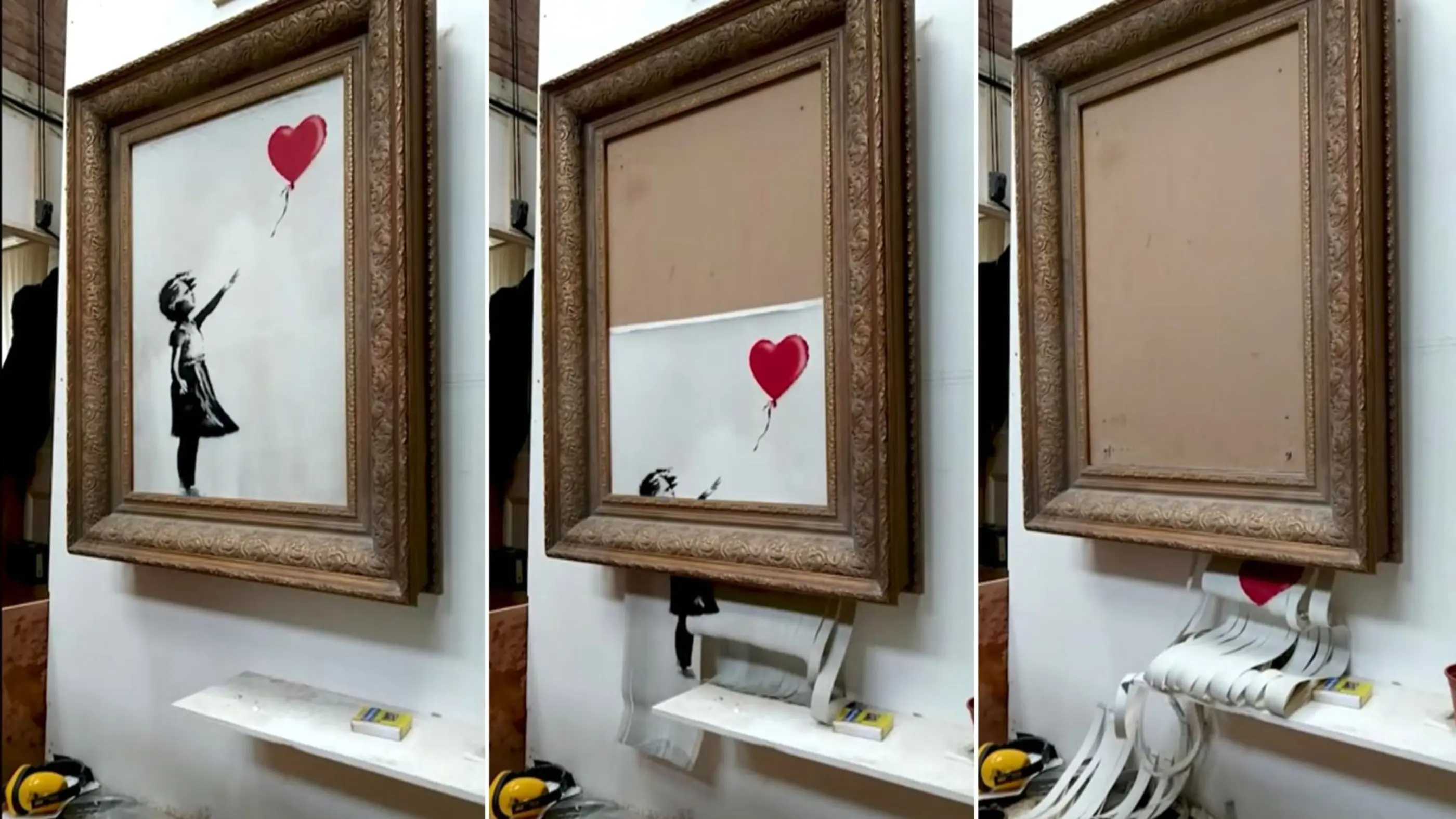
Eight years ago, one of the most talked-about moments in contemporary art unfolded in the middle of a Sotheby’s auction in London. Banksy’s Girl with Balloon had just sold for £1.04 million when the artwork began to slide through a hidden shredder concealed within its frame. The room watched as the image was partially destroyed. What followed was one of the most audacious and revealing interventions in recent art history.
Banksy had already spent years turning art into events: Dismaland, his museum interventions, The Walled Off Hotel… but on 5 October 2018, he found a new stage: one of the world’s most prestigious auction rooms.
What happened there was almost perfectly designed for the age we live in. It was visual, absurd, instantly understandable and captured on camera.
There was a famous artist, a million-pound artwork, a room full of bidders and a shredder hidden inside the frame.
So, was it an act of destruction? A critique of the art market? Or simply the most elaborate art-world stunt anyone had pulled off?
Perhaps it was all three. What was certain, though, was that nobody seemed quite sure who was in on the joke.
From Girl with Balloon to Love is in the Bin
At the beginning of the evening, the work going under the hammer was Girl with Balloon: a unique 2006 piece in spray paint and acrylic on canvas, mounted on board and presented in one of Banksy’s distinctive, oversized frames.
It was the last lot of the sale, and the bidding was intense, already reaching more than three times the high estimate.
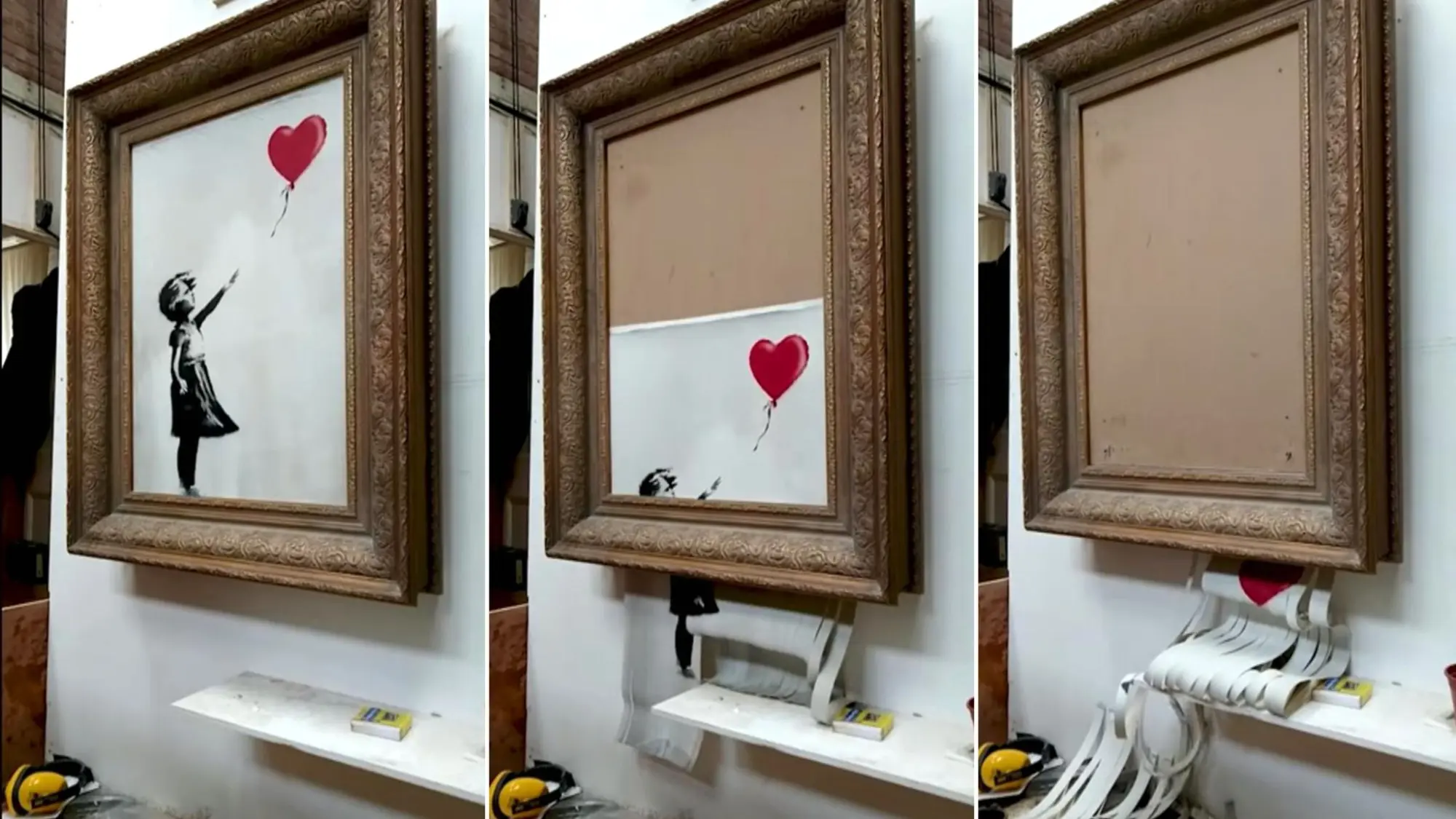
From Banksy's video explaining the mechanism used in the shredding stunt.
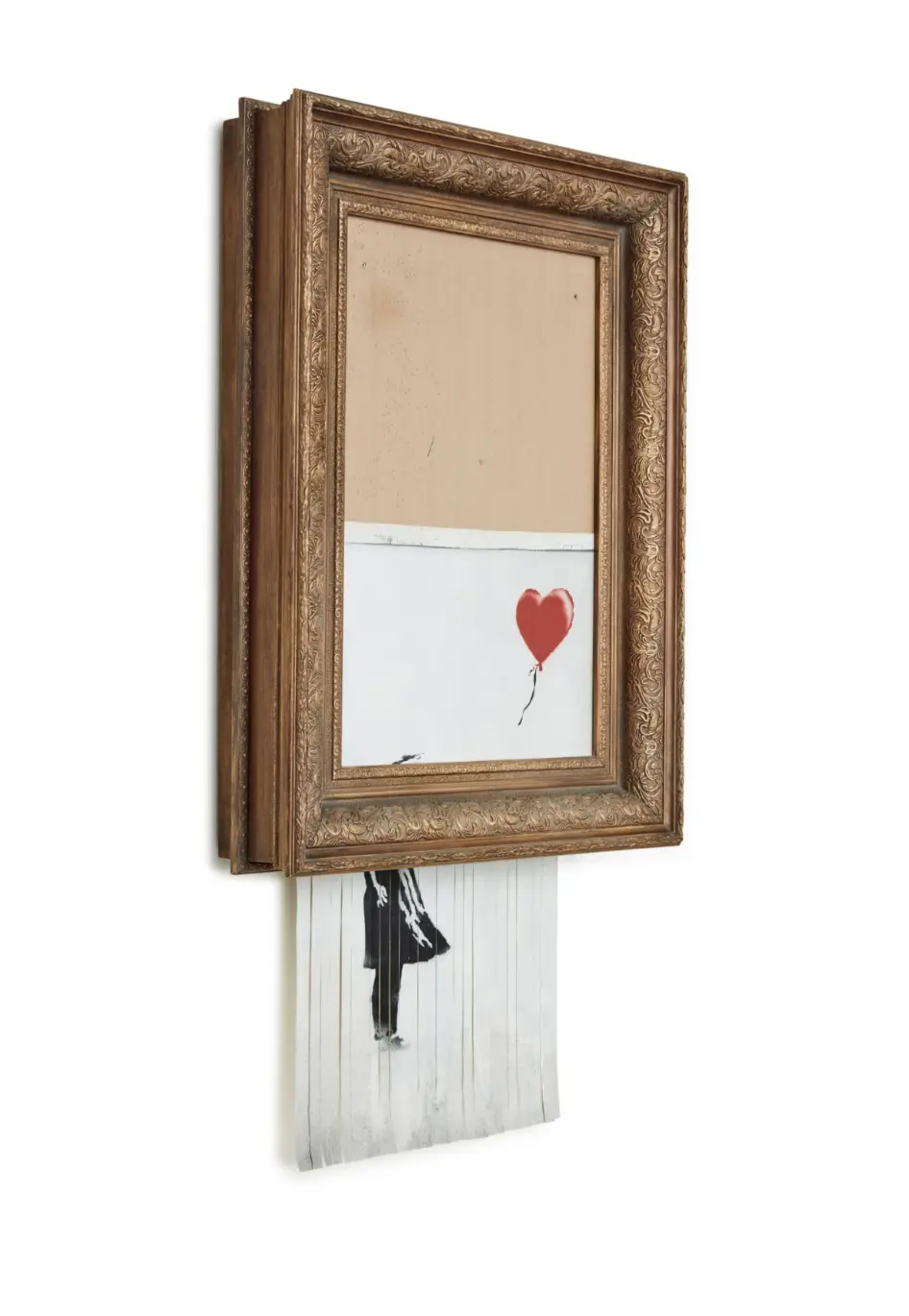
Then the hammer fell, and seconds later, the canvas began to slide down through the bottom of the frame and into the hidden shredder. The mechanism stopped partway through, leaving the girl hanging in strips while the balloon remained intact above her.
The work that had entered the auction as Girl with Balloon was gone. Banksy subsequently gave the surviving work a new title: Love is in the Bin. Its catalogue description now records the partially shredded canvas, frame and mechanism as intrinsic to the piece, with 2018 listed as its completion date.
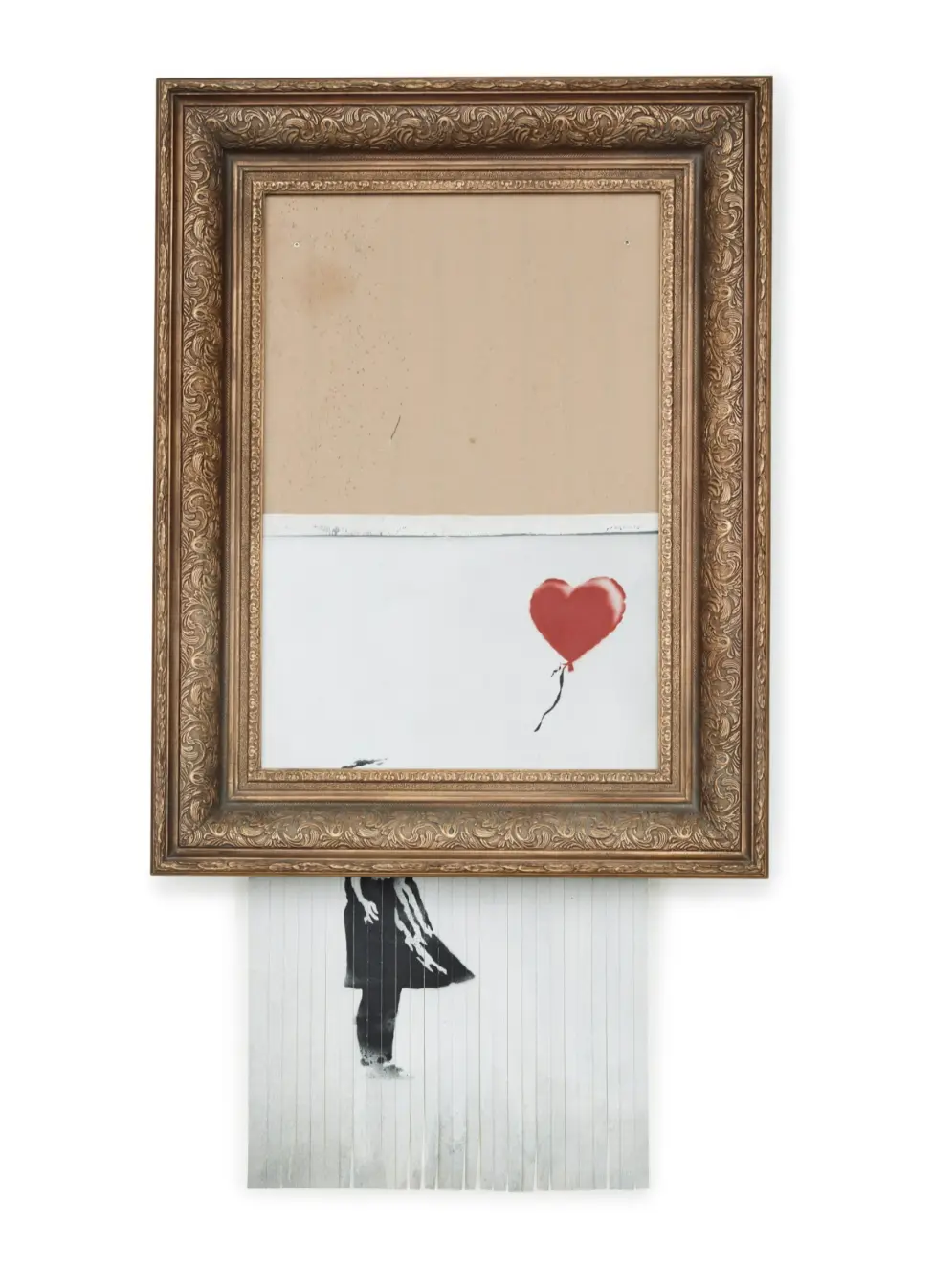
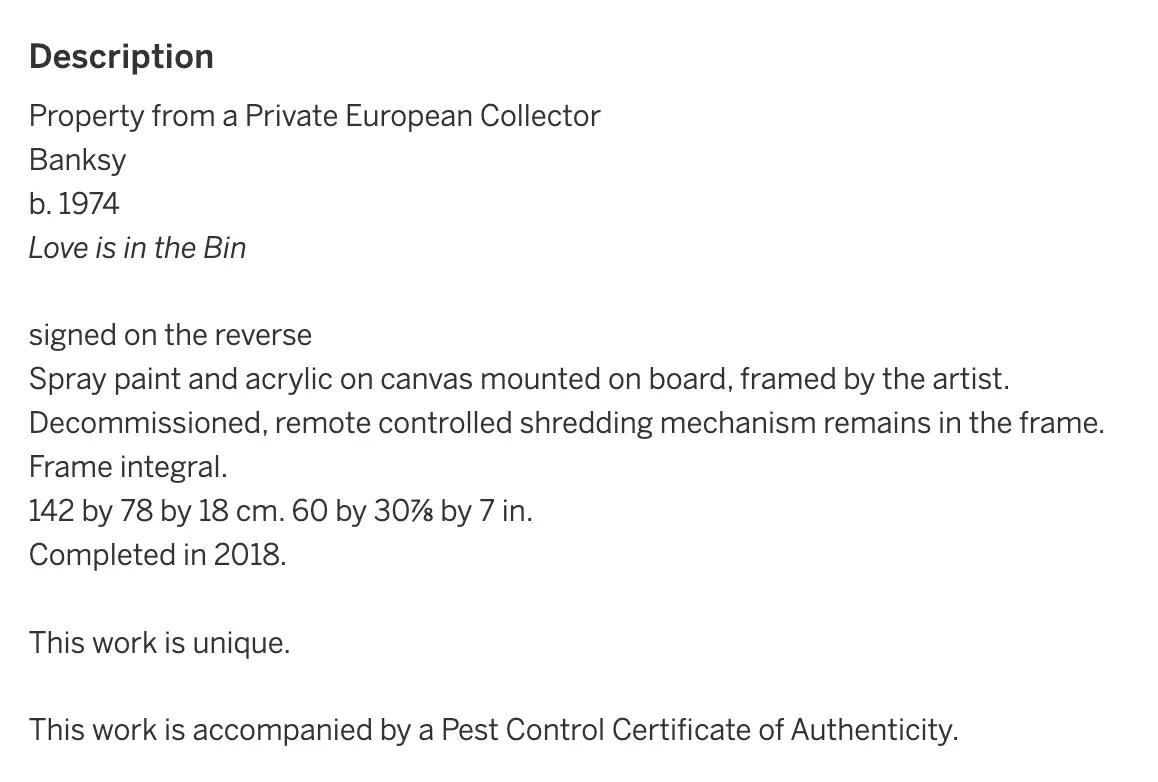
'Love Is in the Bin' catalogue description.
The artwork was no longer simply the image Banksy had made in 2006. Its history had become part of the work itself.
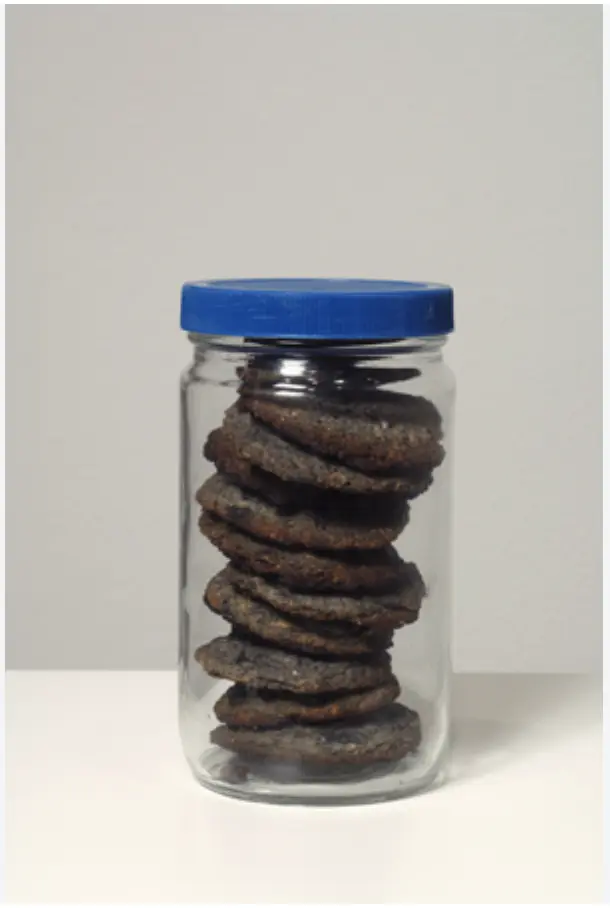
The Cremation Project by John Baldessari. In 1970, Baldessari burned most of the paintings he had made between 1953 and 1966.
Destroying Art Is Nothing New
The idea of destroying, altering or destabilising an artwork is hardly unique to Banksy.
Throughout the 20th century, artists repeatedly challenged the idea that art had to be permanent, precious or even physically intact. From Marcel Duchamp questioning what could qualify as art to John Baldessari burning his own work, destruction has often been used as a way of questioning artistic value and authority.
Banksy’s intervention belongs to this broader tradition, but with one crucial difference: he understood the power of the spectacle.
He didn't destroy the work quietly in a studio. He did it at auction, in front of an audience, at the precise moment when the work became a commodity.
Banksy vs. The Establishment
Banksy has always occupied an unusual position within the art world. He has long taken aim at museums, galleries, consumer culture and the commercialisation of art, while simultaneously becoming one of the world’s most recognisable and valuable contemporary artists.
But rather than simply rejecting the art establishment, Banksy has learned to work within it. The Sotheby’s stunt was a perfect example.
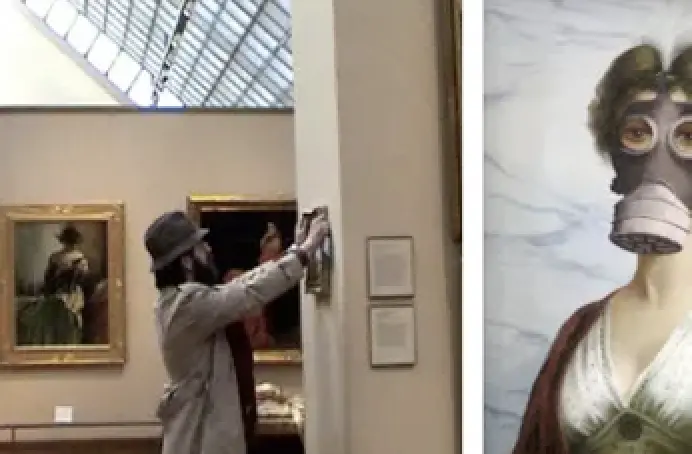
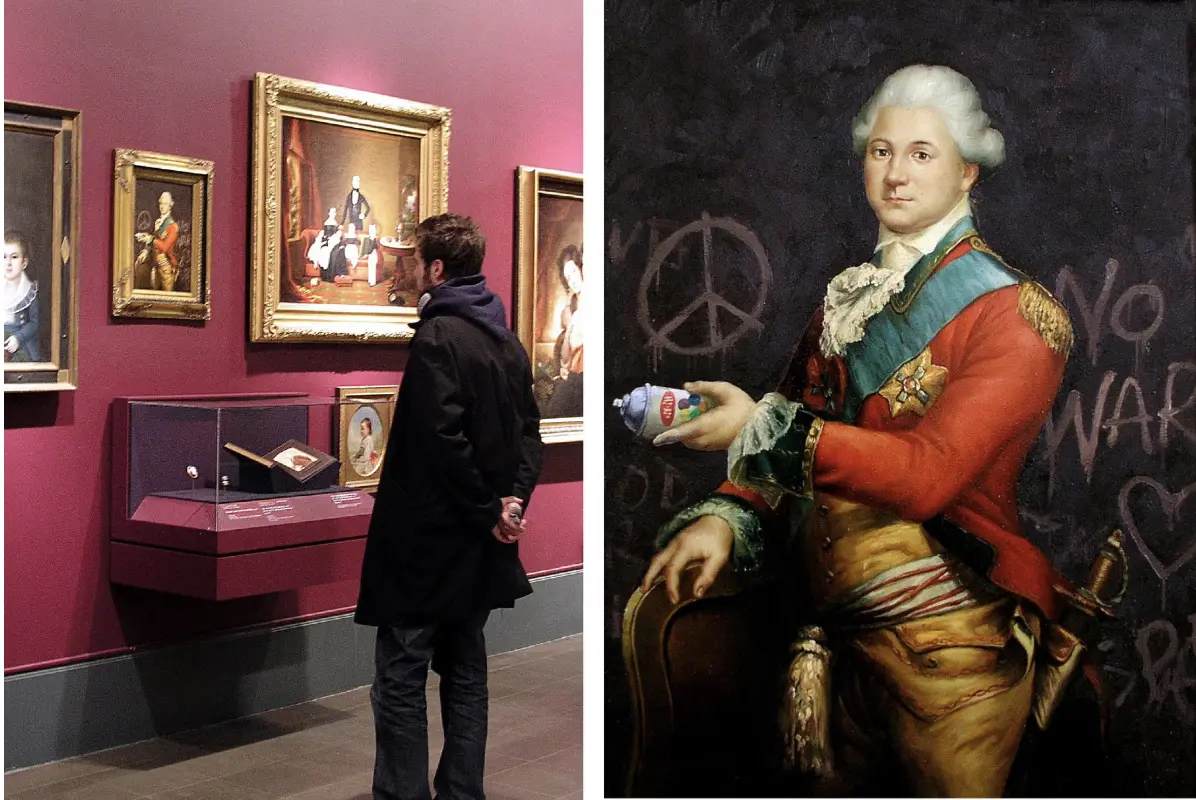
In 2005, Banksy infiltrated four major New York museums.
Banksy didn’t need to stand outside the institution and criticise it. He could use the very system he was questioning to make his point. And that is what made the intervention so effective.
The Auction Room as Theatre
An auction is already a highly theatrical environment. There is anticipation, competition, money, status and the knowledge that something valuable is about to change hands.
Banksy amplified all of it by making the auction part of the performance, rather than simply the setting. The bidders became his audience. The sale itself became part of the artwork.
And the artwork was no longer simply being bought and sold. It was actually doing something!
This is where Banksy’s intervention becomes more than a stunt. He understood that the contemporary art market is not only a system of valuation. It is also a system of spectacle, one where the story surrounding an artwork can become almost as powerful as the object itself.
The Joke That Made £18.5 Million
And then came the ultimate irony.
The work that appeared to mock the commercial art world did not become less valuable because of its destruction. Quite the opposite.
In 2021, Love is in the Bin returned to Sotheby’s and sold for £18.58 million, more than eighteen times the £1.04 million achieved three years earlier.
The market had absorbed the joke. Or perhaps the joke had always understood the market better than anyone else.
Love is in the Bin remains fascinating in part because there’s still a sense of mystery surrounding some of the questions raised by the stunt.
But perhaps what gives the work its lasting power is the striking contradiction at its heart: it was created as a critique of the art market, yet became a highly valuable market object and, in fact, is now Banksy’s most expensive piece ever sold at auction.
A prank that became part of art history. Quintessentially Banksy.
Contributors
Laura Rivas-Lopez
More from Artists
-
04 Nov 2026
The Anatomy of Damien Hirst: 5 + 1 Key Influences to Understand His Practice
Behind the formaldehyde tanks and diamond skulls sits a genuine obsession with art history, clinical science, and old-school traditions of...
-

26 Oct 2026
David Hockney in Numbers
£67.4 million paintings, 90-metre friezes, and a stockpile of 2,000 emergency cigarettes. Step inside the monumental life of David Hockney...
-
14 Oct 2026 4 min read
Meet Louis Fratino
Some artists invite us to look at the world differently; others remind us to look more closely. Louis Fratino does...
-
06 Oct 2026 4 min read
Warhol Without Limits: Rare Works Revealed
Think you know Warhol? Look again. Behind the celebrity portraits lies a wealth of drawings and rare prints that reveal...
-
29 Sept 2026 3 min read
Why Raymond Pettibon Keeps Returning to the Wave
For more than 40 years, across works on canvas, paper, and prints, the wave has been a leitmotif in his...
-
29 Sept 2026 4 min read
From Vasarely to Egypt: 5+1 Influences to Unpack Bridget Riley’s Practice
If you’ve ever stood in front of a Bridget Riley painting, you know that looking at her work is a...
-

25 Aug 2026 5 min read
Andy Warhol’s Flowers: How the Humble Hibiscus Became a Pop Icon
From delicate hand-drawn roses to electric hibiscus blooms, flowers were a recurring motif throughout Andy Warhol's career. At once beautiful...
-
25 Aug 2026 5 min read
Keith Haring: Drawing the Dolphin
At first glance, Keith Haring’s "Man On Dolphin" appears playful and uncomplicated. Look a little closer, however, and the scene...
-
20 Jul 2026 3 min read
Collector's Guide: Damien Hirst | Spots
Once you become synonymous with an image, have you hit the big time? There are 3 main subjects that Damien...
-

13 Jul 2026 3 min read
Collector's Guide: Bridget Riley | Lozenges Series
Take a deep dive into one of Bridget Riley's most acclaimed series: Lozenges.
-
05 Jul 2026
David Hockney - A Life of Looking
David Hockney has died aged 88. He was artist who will be remembered for an illustrious career that spanned many...
-
22 Jun 2026
A Life Size example of Banksy’s Love Is In The Air Headlined Sotheby’s Evening Sale
One of Banksy’s most enduring images headlined Sotheby’s Modern & Contemporary Evening Auction in London this week, as Love Is...